

Julia and Axel - Thirty Years of Favourite Stories

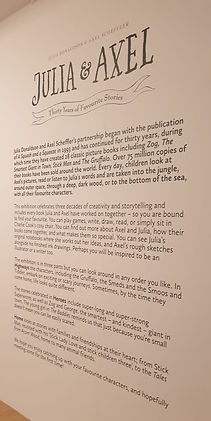
I visited the Lowry to see the “Julia and Axel – Thirty Years of Favourite Stories” exhibition. It
was a collection of their work over the past 30 years, including their planning and notes, sketchbooks and notebooks, and original paintings. The exhibition was beautifully tailored to create a fun and engaging space for children and adults alike!
The reason for the visit was to gather research for my contextual review. The books this pairing has produced for the past 30 years have lots of fantastical elements to them and whilst I might not particularly like Axel’s illustration style, he certainly knows how to capture the imaginations of young children!
I was surprised by the exhibition, I was expecting a few original paintings on the walls and some of their notebooks but what was delivered was far more extravagant! There were lots of rooms with sections divided and focussed on the various books with various interactive games and activities, and cosy and magical spaces created with lights and wonderful prop and set designs.
The exhibition had lots of hidden secrets; with little circle boards you could swivel to reveal a message underneath. There were illustrations with handles that when you lifted them revealed another illustration with what happened next on it. There was a room built inside a room, that felt like a cosy safe space with lights twinkling around it and inside you are invited to sit and colour your own Axel Scheffler colouring pages.

This was a fabulous example for my work, of how children's picture books ignite children's imaginations. For decades Julia and Axel’s books have brought humour, fantasy, and whimsy to the lives of countless children, and inspired them in ways we could never know.
The exhibition was an extension of this, immersing its visitors into the world of the writer and illustrators’ creations, each wall was a visual delight with large scale versions of characters, whole environments and scenes plastered everywhere. Watching how children lit up and moved around the space with such joy shows how impactful children’s books are and a well-designed well-crafted exhibition can act as a wonderful opportunity to step into a world that so far children had only seen in small books on their laps or on their TV or viewing devices.

The exhibition designers really thought about its audience, children’s books, and the stories within them are exciting, they are adventures, they are worlds in which to engage with whole new characters and creatures. If the exhibition was the stereotypical painting in frames on walls, they would have lost the charm and magic of these books and the way that children connect with them. Instead, a charming event was created to continue to inspire both adults and children, it provided an opportunity for children and their loved ones to bond over a shared love of their favourite characters and stories and sought to educate further, for those interested, on how the creators planned and created these stories and images.

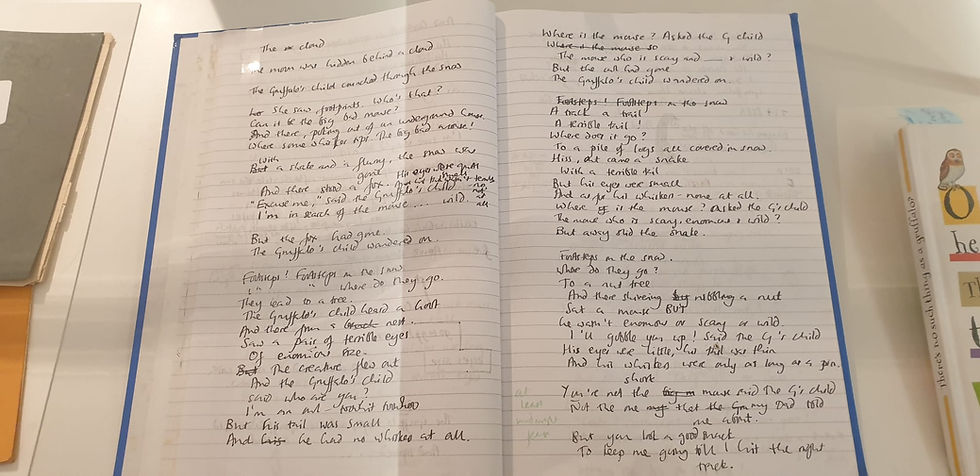
My purpose for going was to find out more about the behind the scenes of the story making process, how Julia plans her writing and Axel’s creative process for the books, but I found myself repeatedly getting swept away by the visuals, the activities and enjoying the moment with my children who are both huge fans of these stories. It gave me a newfound respect for both creator’s work. As I walked around, I tried to work out what it was about these stories that captured children's attention so much. It wasn’t like one story was more popular than another, in listening as I was observing the space, I’d hear an adult say “I loved this story when I was a kid” “This was my favourite” a child Running up to stickman “Stickman!! He’s my favourite” it seems these stories do an excellent job of being something for everyone, there was no one space or book that seemed to garner interest more than any other. I was able to identify a few themes that I think helped make these stories successful that I can link back to my research and practice.
As I have looked through various children’s picture books, specifically the fantastical and magical, there always seems to be a lot of nature, even in Julia and Axel’s stories. Zog, the Gruffalo, even the Smeds and Smoos, all have a scenery of our world’s nature about them. I believe this could be because if you want to take someone off on a fantasy adventure, you need something to help them feel anchored enough to allow them to let go. Nature is something we have all grown up around since as long as humans have existed, it makes sense to us, trees, grass, water, they are all things we have seen and know, they are familiar. I think for children, you need something in the book that grounds them, otherwise it becomes silly nonsense that not even they can follow even with their wonderful fluid minds and so this is why I believe nature tends to be quite a big feature in a lot of fantasy and children's fantasy picture books.

Humour is also a massive component for Julia and Axels’ stories, I believe there needs to be a bit of silliness and playfulness for any fantasy to be successful, it certainly seems the case with these stories. I love the simple humour of the story of the Gruffalo, this isn’t a massively fantastical story, but its not realism either. It’s the running joke that’s woven through the whole story that makes it engaging and keeps the reader going as their expectations are subverted three times with a delightful pay off to the joke at the end. Humour can be a great tool for helping fantastical stories have something that again is familiar and grounding. The joke in the Gruffalo only works because of a child’s knowledge that a mouse is small, and all the other animals could easily eat it, but the mouse is clever and cunning, children can probably identify with the mouse, hoping to be able to have the same kind of quick wittedness and ability to play tricks so well.
In terms of visual representation of the story, Axel’s illustrations always fell flat for me as a kid and even more so as an adult, however this visit opened my eyes to something. I believe one of the reasons Axel is so successful is because his illustrations are quite simple and representational, another grounding element. This isn’t to say his illustrations are easy or uninteresting, but from a child’s perspective, being able to instantly understand what it is they are looking at, makes it easier for them to get a grasp on what it is that is happening, especially if you are going to have stories about aliens, dragons, witches and living scarecrows or stories with talking animals. His imagery is bold, easy to read and interpret and the style is humorous, the characters always look kind of goofy in a way that suits the stories that are being told, which I imagine is quite appealing to children who want to have fun when they are reading a book.

It's made me consider, how much do I let my work be dictated by my own taste level vs the tastes of children and the people in their lives who buy them books?
Given that their parents and loved ones probably had these books growing up too, or the likes of Roald Dahl and Quentin Blake, another illustrator whose work is quite representational and simple on the face of it (though it requires a lot of skill to create simple images!). They would most likely pick something they are familiar with (sensing a pattern with familiarity here?), I have no researched evidence for this, but it could be the case that once they have run out of options for what they know they would select outside into the realm of somewhat familiar, books with a similar style or theme.

I’ve noticed, purely from an anecdotal position, that unless you are actively interested in children's books and children's picture book illustration the idea of selecting a good book for a child from such a ginormous collection can be quite overwhelming. It’s probably why libraries and bookshops have sections where they layout the most “popular” or “pick of the week” you can at least know that someone with knowledge has stated that these books are good.
I’m wondering if sometimes, books can come across as intimidating or pretentious if they are overly highbrow, especially in the context of children's picture books. This is helping me to understand my work in the context of how others see it. Sometimes there's a call for beautiful complicated well-crafted images, sometimes what a story and what a reader needs are simple well-crafted images. I have a taste level, I want to develop that within my work, but I need to consider how well it translates across for the types of stories being told and the readers viewing it.
In summary, this exhibition was remarkably enlightening for me as an illustrator and provided wonderful memories for both me and my children.
“I hope the children who visit will enjoy being inspired to create their own words and pictures.” - Julia Donaldson
Comments